Part of

Partnered with

.svg)
pacemaker.ai's Replenishment Decision Intelligence makes item-level reorder decisions across your entire inventory: what to order, how much, and when. It learns your demand patterns and lead times, then recalculates every day. Less stock and fewer stockouts, all at the same time.
.svg)
.png)
.svg)

.svg)

In most companies, restocking decisions are spread across Excel lists, ERP
exports and the experience of a few planners. It works until the assortment
grows, lead times start moving, and demand stops behaving. Then the same
questions pile up every morning: what's about to run out, what's overstocked,
and which of ten thousand items actually need attention today.

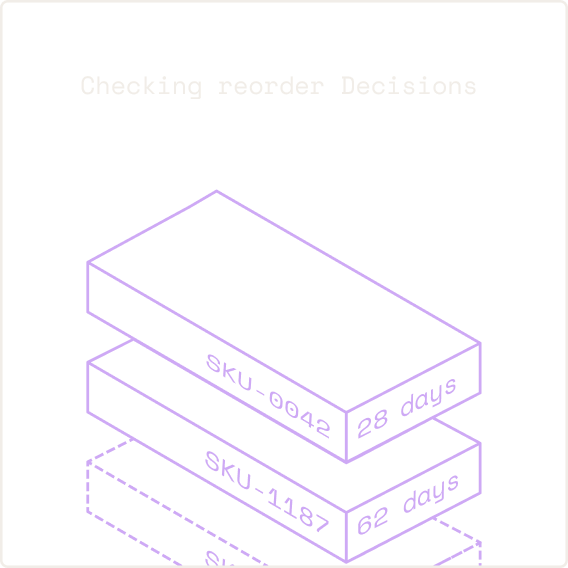
Same SKUs, different reorder decisions. Each square is one SKU.
.png)
.png)

The system plans each item individually, generates order proposals automatically, and adapts them in real time as new data comes in. Historical trends, seasonality and external factors feed a purchasing strategy that moves when your market moves.
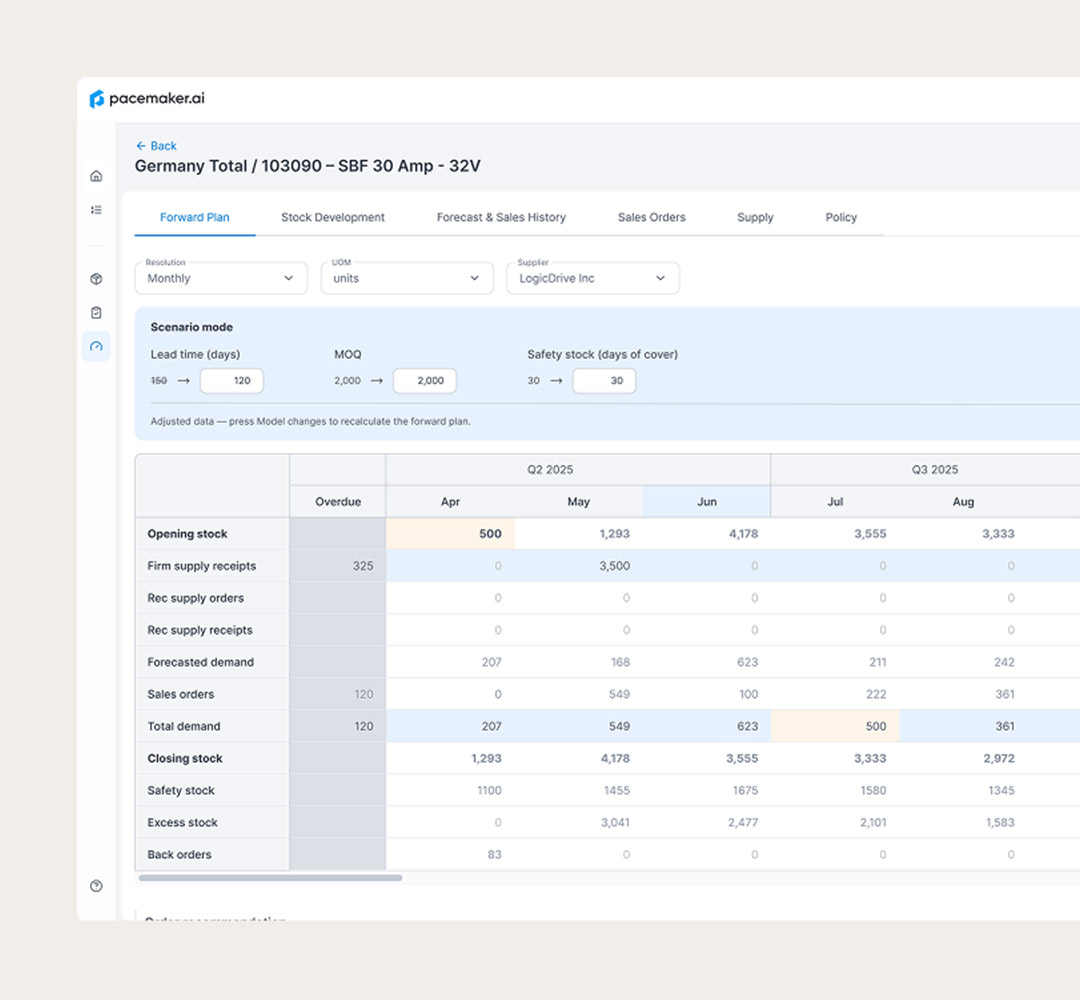
Lead time is not a static field in your ERP. The system forecasts it from your own history by supplier, site and material, plus order quantity, port proximity and holidays like Chinese New Year. When a lead time stretches, it recalculates the downstream effects and adjusts the recommended order quantity to protect future availability.

Not every item needs attention every day. The system highlights the ones that do, like a supplier delay or a demand spike, so your team works on the 50 items that matter instead of scrolling past the 9,950 that don't.

Clear dashboards and simulation tools show the reasoning behind every recommendation. Planners see the trade-offs, adjust safety stocks or lot sizes, and stay in control. The AI proposes, your team decides.

Review Cycle sits inside your S&OP process and keeps every reorder
decision current, no matter when the next planning run happens.

New demand and supply signals arrive every day.

Forecasts and reorder points recalculate on their own.

The latest view is there for your next planning run.
.svg)
Better reorder decisions cut inventory cost while keeping service level steady at the top.
.svg)
.svg)
.svg)
.svg)
thyssenkrupp Aerospace runs Replenishment Decision Intelligence across one of the most complex spare-parts inventories in the industry. If it holds up there, it will hold up in your supply chain.
Replenishment refers to the systematic restocking of inventory to maintain optimal product availability. Effective replenishment management involves the strategic planning of reorder timing and quantities, in order to avoid supply shortages while reducing excess stock at the same time. Modern replenishment uses AI-driven algorithms and data-based forecasts to make precise inventory decisions across the supply chain.
In many companies, replenishment planning is highly fragmented: tools are disconnected, lists are kept manually in Excel, and there is little transparency; decisions come from experience rather than the underlying data; demand changes and supply delays are noticed too late; there is no prioritization of which products are critical; and too much effort goes into routine decisions, leaving little time for strategic questions. This is exactly where our tool comes in: it automates daily planning, identifies deviations early, and helps you make well-founded decisions faster, more precisely, and with less effort.
Our replenishment tool analyzes your inventory, lead times, and demand data at the item level for optimal replenishment planning. Using AI, the system forecasts future demand and automatically proposes the optimal replenishment timing and order quantities. Critical products are actively highlighted in the replenishment dashboard, so your purchasing team only needs to step in where it is genuinely necessary. The system continuously adapts to new data, fully dynamic and self-learning.
The Review Cycle supports the S&OP supply planning phase with a structured, repeatable approach. It gives planners all the key data in one place, including system-based reorder recommendations, so every decision is well informed while the planner stays firmly in the driver's seat. The Review Cycle also enables fully interactive planning: review materials, enter or edit order quantities, add comments, and move items to the Shopping List, all in a single tool. No Excel export is required, though it remains available whenever you need it.
Modern replenishment differs significantly from traditional inventory planning.
- Traditional methods: manual, Excel-based reordering, static safety stocks, reactive restocking
- Intelligent replenishment: AI-driven forecasts, dynamic adjustment, proactive inventory optimization, automated replenishment decisions
The result: more precise restocking, reduced capital lock-up, and higher service availability through professional replenishment management.
Manual planning quickly reaches its limits, particularly with a large number of SKUs, volatile markets, and limited resources. Our solution offers automated item-level planning instead of blanket rules, exception-based alerts that direct attention to critical items, real-time adaptation when demand or supply changes, and strategic scenarios for optimizing safety stocks, lot sizes, or supplier choice. The outcome: you increase availability, reduce inventory costs, and take pressure off your teams.
Replenishment Decision Intelligence builds on the demand forecasts from our Demand Forecasting product and translates them into concrete ordering and planning decisions. While demand forecasting on its own gives you the prediction, replenishment automates the next decisive step: optimal order quantities, safety stocks, and reorder points, per item, per location, continuously adjusted. For thyssenkrupp Aerospace, pacemaker.ai implemented this combination and replaced manual planning, with measurable results: up to 36% fewer stockouts and cost savings of up to 33%. It is only with Replenishment Decision Intelligence that a forecast becomes a genuine lever on your inventory.
With AI demand forecasts and intelligent replenishment, manufacturing companies typically reach service levels of 97–99%, without increasing safety stock. The prerequisite is clear service-level differentiation by item class: A-items at 99% or higher, C-items at 92–95%. Among pacemaker.ai customers, out-of-stock incidents typically fall while overall inventory is reduced at the same time.
There are several proven replenishment strategies for optimal restocking:
- Push replenishment (demand-driven): based on demand forecasts and planned figures, before actual demand occurs.
- Pull replenishment (consumption-driven): restocking happens only when defined minimum stock levels are reached.
- Min-max replenishment: automatic restocking between defined minimum and maximum levels.
- Periodic replenishment: regular reordering at fixed intervals, regardless of current stock.
- AI-driven replenishment: machine learning algorithms combine multiple factors for optimal decisions and automated restocking.
Intelligent replenishment systems are particularly well suited to companies with complex restocking requirements: complex assortments with many items on different replenishment cycles; seasonal products with varying demand patterns; industries such as automotive or aerospace that need reliable, critical availability; operations with high inventory costs where precise control affects profitability; and volatile markets that require rapid strategy adjustment. Industries such as retail, manufacturing, consumer goods, logistics, and spare-parts management benefit most.
Our replenishment software is designed for seamless integration into existing IT landscapes. Replenishment solutions can be connected via APIs to ERP systems, inventory management software, and other enterprise systems. Implementation takes place without disrupting ongoing processes. The system works as an intelligent addition for optimized restocking within your existing supply chain infrastructure.
The fastest way to know if this fits is a short walkthrough. 30 minutes, no slide deck. We show you how Replenishment Decision Intelligence works and answer your questions against your real situation.